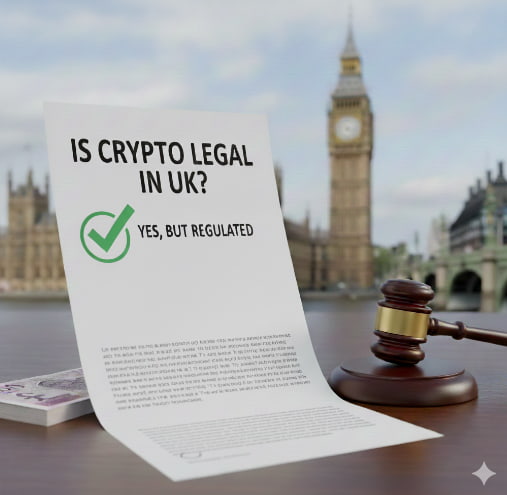
Crypto is legal in the UK, but regulated. FCA rules, financial promotion restrictions, and HMRC taxation apply depending on the activity. Personal use is permitted, but business operations must adhere to regulations.
In order to understand what the legal boundaries are, it is necessary to examine how UK regulators classify cryptoassets, which activities trigger mandatory supervision, and what obligations apply to individuals and firms operating in this space.
In this article, we will take a look at a structured review of the important regulatory authorities, compliance standards, taxation rules, and major legal milestones that affect the crypto ecosystem in the UK today.
Key Takeaways
- Crypto is legal property in the UK, but not legal tender, and is tightly regulated
- FCA registration is required for firms serving UK consumers
- Consumer protection is limited and losses are usually uninsured
- Compliance focuses on strict AML/CTF obligations.
- Firms must have an MLRO, strong KYC, and continuous transaction monitoring
- Rules aim to protect consumers from scams and financial crime
- Crypto is highly volatile, so investors should stay cautious and keep good records
Key Legal and Regulatory Events for UK Cryptoassets
This timeline illustrates the significant legal and regulatory milestones that have affected the UK crypto ecosystem from 2018 to 2025. It gives a clear picture of how oversight has changed by covering important changes such as financial promotion regulations, AML/CTF supervision, FCA guidelines, and new laws.
| Date | Regulatory / Legal Event / Rule | Description / Significance |
|---|---|---|
| July 2018 | Cryptoassets Taskforce final report published by government (HM Treasury, Financial Conduct Authority (FCA), Bank of England) | This report laid out initial government thinking on crypto‑assets and the risks/opportunities; it helped set the foundation for later regulation. (GOV.UK) |
| January 2020 | FCA becomes AML/CTF supervisor for UK cryptoasset businesses under the Money Laundering, Terrorist Financing and Transfer of Funds (Information on the Payer) Regulations 2017 (MLRs) | From this date, any UK business providing crypto‑asset exchange, custody, or other “in‑scope” services must register with the FCA and comply with AML/CTF rules. (FCA) |
| September 2023 | Implementation of the “Travel Rule” for cryptoasset transfers in the UK | Cryptoasset firms must collect, verify, and share payer and payee information for transfers — aligning crypto transfers with broader financial‑crime prevention standards. (FCA) |
| October 2023 | Introduction of the cryptoasset financial promotions regime under the FCA / financial‑promotion rules | Firms (even overseas) marketing cryptoassets to UK consumers must comply with the new promotion regime — ensuring marketing meets regulatory standards. (FCA) |
| December 2024 | Publication of discussion paper DP24/4: Regulating cryptoassets – Admissions & Disclosures and Market Abuse Regime by FCA | This marks the start of formal development of additional regulated‑activities regimes for crypto — including rules on market abuse, disclosures, and admission requirements. (FCA) |
| April 2025 | The Financial Services and Markets Act 2000 (Regulated Activities and Miscellaneous Provisions) (Cryptoassets) Order 2025 (draft statutory instrument) published by HM Treasury, with accompanying Policy Note | The draft legislation aims to formally bring many crypto‑related activities (exchange, custody, stablecoin issuance etc.) within the UK financial‑services regulatory perimeter. (GOV.UK) |
| 2025 (ongoing) | New regulatory regime being developed; consultation and rule‑making by FCA and HM Treasury envisaged for cryptoasset trading platforms, custody, stablecoins, market abuse, disclosures etc. | This shows the shift from AML‑only oversight to a broader, full‑fledged regulatory framework for crypto — comparable to traditional finance. (FCA) |
Crypto Regulation and Legal Status in the UK (2025)
As of December 2025, cryptocurrencies are legal in the UK, but they are highly regulated depending on how they are used. The UK government does not classify crypto as legal tender, meaning it is not recognized as official money.
They are treated as property rather than legal tender and are subject to strict regulations depending on the nature of activities they are involved in. However, it can be legally bought, sold, held, and traded.

Below is a simple breakdown of how cryptocurrency is regulated and taxed for individuals, corporates, and crypto service providers in the UK.
Individuals / Retail Users
- Ownership and Trading: It is legal for people to purchase, hold, and sell cryptocurrencies for their own investment. Personal trading does not require a license.
- Taxation: Capital Gains Tax (CGT) applies to profits made from the sale or exchange of cryptocurrency. Income received as crypto (e.g., salaries, airdrops) is subject to Income Tax.
- Consumer Protection: Although UK legislation provides minimal protection for retail consumers, there is no assurance of insurance or reimbursement in the event that a platform mismanages, loses, or steals cryptocurrency holdings.
- Financial Promotions: Individuals may only purchase crypto products offered by entities complying with FCA financial promotion rules (certain derivatives and high-risk products remain restricted for retail users).
Businesses / Corporates
- Corporate Ownership: Companies can store cryptocurrencies on their balance sheets as property or assets. In general, corporate profits from cryptocurrency operations are liable to Corporation Tax.
- Crypto Payments: Corporates may utilize cryptocurrency for fundraising or payments (such as issuing tokens), but if the activity is classified as “regulated services,” they must abide by FCA and AML/KYC requirements.
- Regulatory Oversight: Companies that run cryptocurrency exchanges, custody services, or financial services relating to cryptocurrencies must be FCA-registered and adhere to financial reporting, sanctions screening, and AML/KYC regulations.
Crypto Firms / Service Providers
- Regulated Activities: Any firm offering exchange, custody, issuance, or trading services for crypto must register with the FCA and adhere to Money Laundering Regulations, Travel Rule compliance, and financial promotion restrictions.
- Stablecoins & Payments: The Bank of England is in charge of monitoring companies that run payment networks or issue stablecoins, especially if these products are systemic.
- Cross-Border Services: International AML requirements and local UK regulations, including additional due diligence for high-risk jurisdictions, must be followed by businesses that facilitate transactions involving overseas clients.
| Participant | Legal Status | Regulatory Obligations | Tax Treatment |
|---|---|---|---|
| Individuals | Legal to buy, hold, sell | Must use FCA-compliant platforms; limited consumer protection | Capital Gains Tax; Income Tax on crypto income |
| Corporates | Legal to hold/use crypto | FCA registration if offering services; comply with AML/KYC, sanctions, and financial reporting | Corporation Tax on profits; VAT may apply for services |
| Crypto Firms / Service Providers | Must be FCA-registered | AML/KYC, Travel Rule, financial promotion rules, sanctions compliance, audit/reporting obligations | Tax depends on corporate structure and activity |

Key Regulatory Authorities
The UK’s cryptocurrency market is regulated by key authorities responsible for enforcing compliance, maintaining financial stability, and protecting consumers. Each organization has distinct responsibilities for monitoring various facets of cryptocurrency operations.
Below is a brief summary of the main authorities overseeing crypto in the UK:
| Authority | Role |
|---|---|
| Financial Conduct Authority (FCA) | Oversees crypto businesses in the UK, ensuring they comply with AML/KYC requirements and regulating the promotion of crypto products. |
| HM Treasury | Provides overall policy guidance and sets the legislative framework for cryptocurrency regulation. |
| Bank of England (BoE) | Maintains financial stability and supervises systemic payment systems, including those involving stablecoins. |
| HM Revenue & Customs (HMRC) | Responsible for taxation of crypto activities for both individuals and businesses. |
| Office of Financial Sanctions Implementation (OFSI) | Ensures crypto firms comply with UK financial sanctions and enforces related regulations. |
Who gets affected?
Under the UK’s Money Laundering Regulations (MLR 2017 and subsequent amendments), regulation targets specific business activities rather than ordinary users. The law distinguishes between two main types of crypto-related firms:
1. Cryptoasset Service Providers:
These are businesses whose operations generally facilitate the exchange of crypto. This includes companies that:
- Convert crypto to fiat or vice versa
- Help customers swap one cryptoasset for another
- Run automated systems or cryptocurrency ATMs that let consumers purchase and trade cryptocurrency.
Essentially, if a company plays any role in arranging, executing, or automating crypto exchanges, it falls under this group.
2. Custodian Wallet Providers
This group includes companies that deal with users’ private keys or cryptoassets. These companies ensure that users can safely access, transfer, and manage their digital assets by providing safe storage, asset management, and transaction processing services on behalf of their clients.
These providers often implement security methods, key-management systems, and recovery mechanisms, making them a significant point of trust within the crypto ecosystem.
They are subject to stringent regulatory and AML duties in the UK since they effectively hold or control consumer assets.
Compliance Obligations for Affected Firms
Since both categories operate under the same regulatory umbrella, it leads to broader compliance obligations
Overall, both Cryptoasset Service Providers and Custodian Wallet Providers fall directly within the UK’s Money Laundering Regulations, meaning any business that enables, processes, converts, or secures cryptoassets must now operate inside a regulated framework.
If a corporation is involved in exchanging crypto for fiat, enabling crypto-to-crypto trading, running automated systems like ATMs, or keeping users’ private keys and digital assets, it is legally compelled to take action.
To put it briefly, every company that handles consumer cryptocurrency funds or transactions needs to function as a regulated financial service. Heavy fines or being barred from functioning in the area are possible outcomes of noncompliance.
Key Regulatory Requirements for Crypto Businesses in the UK
A stringent regulatory framework intended to guarantee transparency, consumer protection, and financial crime prevention must be followed by cryptocurrency companies operating in the UK.
These restrictions apply to exchanges, custodians, and any entity involved in promoting, transferring, or preserving digital assets. Here’s a basic checklist for businesses planning for involvement in cryptocurrencies.
| Regulatory Point | Description |
|---|---|
| FCA Registration | All UK crypto firms offering exchange, custody, or other regulated services must register with the FCA and adhere with AML/KYC rules. |
| AML / KYC Compliance | Strong anti-money laundering and customer due diligence protocols, which include identifying and confirming clients and beneficial owners, must be put in place by businesses. |
| Financial Promotions | Marketing or promoting cryptoassets to UK customers must comply with FCA financial promotion guidelines to prevent misleading information. |
| Travel Rule Compliance | Crypto businesses must collect and disclose payer and payee information for transfers to prevent money laundering and financial crime. |
| Consumer Protection & Data Security | Businesses must provide safe systems, adherence to the Consumer Duty, and protections for retail customers. |
| Tax Compliance | Crypto transactions for individuals and corporations are subject to UK tax legislation (Capital Gains Tax, Corporation Tax, Income Tax, VAT). |
| Sanctions Compliance | Screening customers against UK sanctions lists and reporting breaches to the Office of Financial Sanctions Implementation (OFSI) is important for firms. |

UK Crypto Regulations for Individuals — A Legal Standpoint
In the UK, individuals are allowed to buy, hold, and trade cryptocurrencies, but their activities are governed by strict tax and consumer-protection rules.
HMRC treats crypto as property, meaning gains and certain types of income are taxable, while the FCA limits which crypto products can legally be promoted to retail users.
1. Legal Status & Regulatory Scope
- The UK does not accept cryptoassets as legal money or fiat currency; instead, they are considered assets/property for numerous legal and tax purposes.
- Owning, buying, keeping, or selling crypto for personal use is not unlawful. There is no blanket ban on personal crypto ownership, trading, or holding in the UK.
- The main regulatory structure (under the Financial Conduct Authority — FCA) is focused on businesses selling crypto services (exchange, custody, wallets, payments, etc.), not individuals buying or keeping crypto for personal use.
- Many consumer-protection measures common to banks and investing (such as deposit insurance or FSCS coverage) do not apply to cryptocurrency holdings because of the regulatory framework. The FCA warns that “if you buy cryptoassets you should be prepared to lose all the money you invest.”
2. Prohibited or Restricted Products for Retail Individuals
- The FCA has issued a formal prohibition on the sale, marketing, and distribution of certain crypto‑derivatives and exchange-traded notes (ETNs) to retail consumers in the UK.
- The restriction is predicated on concerns about excessive volatility, lack of trustworthy value, prevalence of market misuse, and financial‑crime risk.
- While the FCA has recommended lifting the ban (2025) for ETNs under stringent conditions (only via recognised investment exchanges, with clear risk warnings), as of today, for many products, the ban still applies.
3. Taxation & HMRC Treatment for Individuals
The UK tax authority, HM Revenue & Customs (HMRC), provides clear guidance on how cryptoassets are taxed for individuals under various circumstances.
- When crypto triggers Capital Gains Tax (CGT)
- Selling crypto for fiat.
- Exchanging one cryptoasset for another.
- Using crypto to pay for goods or services (i.e. disposal).
- Gifting or disposing of crypto.
In such cases, individuals must calculate their gains or losses, keep accurate records (dates, amounts, cost basis), and report gains above the annual CGT allowance. HMRC’s “Cryptoassets for Individuals” guidance page details this.
- When crypto may be taxed as Income
- Income tax and perhaps national insurance contributions may apply if you receive cryptocurrency as payment or job income (e.g., salary paid in cryptocurrency, airdrops linked to services, mining/staking rewards acknowledged as income).
- HMRC’s internal Cryptoassets Manual provides categories under which crypto may be classified as income, including staking, mining, airdrops, or employment‑related crypto payments.
4. Consumer Warnings & Risk Disclosures
- The FCA regularly warns that cryptoassets are unregulated (for many purposes) and represent substantial risk. In many cryptocurrency circumstances, retail investors are unlikely to have access to protection programs like FSCS or the Financial Ombudsman Service.
- Crypto companies must make it clear in their marketing and promotional materials whether or not their products are regulated. Firms are expected to conform with the UK’s financial promotions framework.
- The FCA has been cracking down on unlicensed cryptocurrency ATMs and unregistered cryptocurrency service providers operating without authorisation since 2023, demonstrating that unlawful or noncompliant operators may be subject to penalties.
NOTE:
- Crypto holdings are not “protected deposits” — no FSCS or guaranteed compensation.
- Many crypto products (derivatives, ETNs) remain banned or restricted for retail individuals.
- Volatility, risk of loss, liquidity issues, and counterparty risk remain major hazards if using unregulated or high‑risk crypto services.

Related Read:
Conclusion: Crypto Is Legal In the UK With Certain Regulations
The UK has a clear stance of “regulate or cease operation” for involvement of businesses in crypto-related activities. The system is extensively embedded in Anti-Money Laundering (AML) and Counter-Terrorism Financing (CTF) procedures, overseen by the Financial Conduct Authority (FCA).
Compliance is a requirement, not an option, for any company looking to interact with the UK market, whether through exchanges, custody, or just targeted marketing.
Cryptocurrencies in the UK are legal for personal use, but individuals operate in a largely unregulated environment, meaning consumers should proceed cautiously with their investments in the digital asset.
Retail investors must manage risks associated with volatility, unregulated exchanges, and prohibited or limited cryptocurrency goods, even if HMRC offers clear tax guidance and the FCA controls business activity.
Understanding legal categories, tax requirements, and FCA guidelines is crucial for individuals to stay compliant and secure their investments.
Still have questions? Check the FCA’s official guidance at fca.org.uk/firms/cryptoassets or consult a financial advisor specializing in digital assets.
FAQ’s
Yes, cryptocurrency is completely legal in the UK. You can buy, sell, hold, and trade crypto without breaking any laws. However, “legal” doesn’t mean “unregulated.”
HMRC treats crypto as property, so CGT applies when you sell, swap, or spend it, and Income Tax applies when you earn it (salary, mining, staking). Always keep detailed records of all crypto transactions.
No. Crypto isn’t protected by the FSCS like bank deposits. If an exchange is hacked, collapses, or disappears, there’s no government safety net, and you’re unlikely to recover your funds.
Yes, but with conditions. Your business can accept crypto, but it must be reported for tax (Corporation Tax applies). If crypto handling becomes a core service, you may also need FCA registration depending on the activities involved.
Yes. Since January 2021, the FCA has banned retail investors from buying. Crypto derivatives (futures, options, CFDs on crypto) and Crypto-backed Exchange Traded Notes (ETNs)
Yes, if you target UK customers in any way, you fall under the FCA’s scope. The FCA can regulate any crypto business, regardless of where it is located, if it markets crypto products to UK residents, accepts UK users for trading or custody, or promotes crypto services directed at the UK market.